


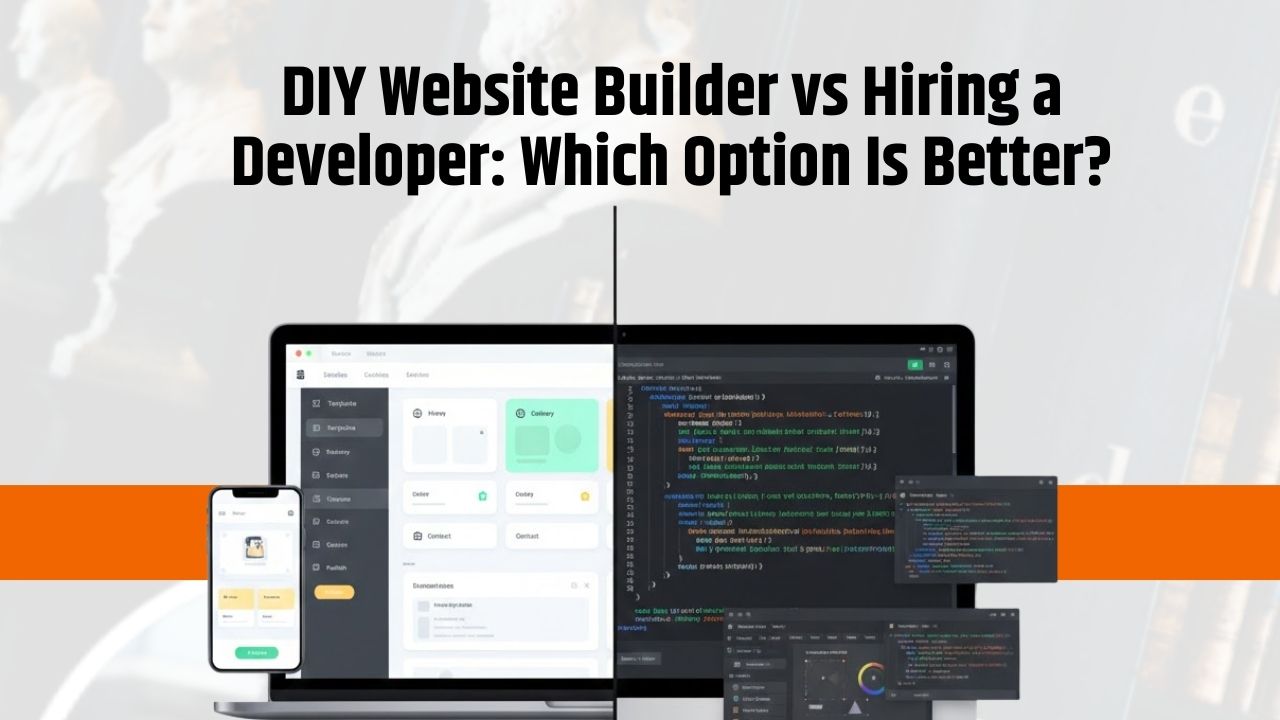
Building a website is no longer a question of if but how. Many small business owners face the same dilemma: should you build the website yourself using a DIY website builder, or should you hire a professional developer to do it for you? Both options are valid, and both are widely used—but they serve different needs.
The right choice depends on a few practical factors such as your budget, how quickly you want to go live, and how comfortable you are managing things on your own. Some businesses need speed and simplicity, while others require deeper customization and technical complexity.
This guide breaks down both options clearly and objectively. By the end, you’ll be able to decide which approach suits your business stage, goals, and resources—without confusion or technical overwhelm.
A DIY website builder is a tool that allows anyone to create a website without coding or technical knowledge. These platforms offer ready-made templates and visual editors where you can add text, images, pages, and features using simple drag-and-drop actions.
You don’t need to understand programming languages or server setup. Everything—from design to publishing—is managed through an easy dashboard. The website is self-managed, meaning you control updates, edits, and changes whenever needed.
DIY website builders are commonly used by:
The biggest advantages are ease of use, fast setup, and affordability. For businesses that want to get online quickly without technical stress, this option feels accessible and practical.
What Does Hiring a Website Developer Mean?
Hiring a website developer means working with a professional who designs and builds a website from scratch or from a custom framework. This approach involves coding, technical setup, and deeper customization.
The typical process includes:
A developer-managed website can offer flexibility in design and functionality. This option is often chosen by businesses with very specific needs, complex workflows, or long-term technical plans. It’s a structured process that requires coordination, timelines, and ongoing communication.
Cost Comparison – DIY Builder vs Developer
Cost is often the deciding factor for small businesses.
Hiring a Developer
DIY Website Builder
For businesses with limited budgets or simple requirements, the cost difference can be significant over time.
Time-to-launch matters, especially for new or growing businesses.
Developer-built websites
DIY website builders
If speed is a priority, the DIY route offers a clear advantage.
Control over your website affects how flexible and responsive your business can be.
DIY Website Builder
Hiring a Developer
For businesses that frequently update offerings or information, ease of use becomes a major benefit.
For most small businesses, a DIY website builder is the more practical option when:
In such cases, a DIY website builder allows businesses to establish an online presence without delays, heavy investment, or technical dependency. It helps owners focus on customers rather than code.
Hiring a developer is a better choice when:
This option suits businesses with advanced needs and dedicated budgets. Choosing a developer in these cases is not wrong—it’s simply a different requirement.
Understanding your actual needs prevents unnecessary expense and delays.
Both DIY website builders and professional developers have their place. The better option depends on what your business truly needs today—not what sounds impressive. For most small businesses, freelancers, and service providers, building a website yourself is faster, more affordable, and easier to manage in the long run.
A DIY approach allows you to go live quickly, stay flexible, and maintain full control without technical barriers. By choosing wisely, you can create an effective online presence that supports growth without unnecessary complexity.
DigiBCard is not just a digital visiting card. It works like a mini website designed for modern small businesses.
With it, users can:
It is suitable for small businesses, freelancers, and service providers who want simplicity. By combining a website and digital card in one place, it removes technical barriers and speeds up online presence creation.
If you want a simple, affordable, and quick way to go online, a DIY website builder can help you launch without delays or technical stress.

Top 10 Reasons to Switch to Digital Business Card

How to Design Digital Business Cards In 4 Easy Steps

Transform Your Networking with a Personalized Digital Business Card

Top 5 Platforms to Set Up Your Digital Store Easily
